Human Time
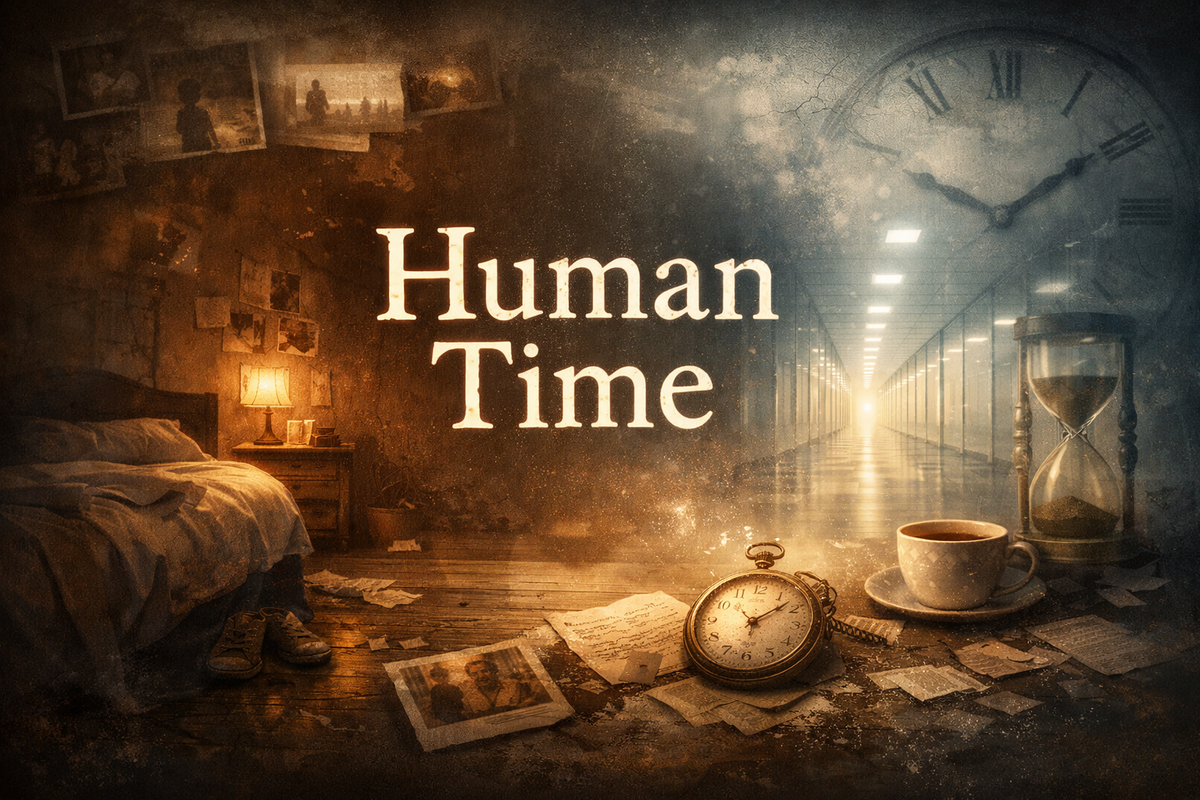
Humans cannot live inside perfect time because perfect time has no interior.
Perfect time is a clean hallway with no doors. It advances whether you are ready or not. It does not slow when grief drags its feet. It does not pause when memory refuses to cooperate. It does not accelerate when joy begs it to stay. It is smooth, indifferent, and tyrannically fair. Every second gets exactly one second. No more. No less.
Physics loves this. Calendars worship it. Clocks enforce it.
But the human mind does not inhabit that hallway. It lives in rooms. Messy ones. Rooms with half packed boxes, old smells, and notes written to people who are not coming back. A human minute can feel like a held breath or a punch to the chest or an entire lifetime compressed into a glance at the ceiling at three in the morning.
Perfect time assumes continuity. Humans operate on rupture.
We wake up already behind. Not behind the clock, but behind ourselves. Behind who we thought we would be by now. Perfect time does not account for the invisible weight that makes lifting a day harder than lifting a year. It does not understand why tying shoes can be harder than filing taxes. It does not know what it means to sit on the edge of a bed negotiating with existence.
Perfect time says now. Humans ask why.
That gap is where psychology lives.
Memory breaks perfect time into shards. Trauma stretches moments into eternities. Anticipation collapses weeks into a blur. Boredom turns hours into sludge. Love creates pockets where time forgets to count. Loss creates cavities where time echoes but never fills the space.
If perfect time were real in the way clocks insist, therapy would be unnecessary. Grief would expire on schedule. Healing would be linear. Progress would be measurable in evenly spaced ticks. None of this survives contact with an actual nervous system.
The body keeps its own clocks, and they are badly calibrated. The amygdala does not care what day it is. The gut does not trust the calendar. The mind routinely time travels without permission. You can be forty five years old and still seven years old in an instant, blindsided by a smell or a sentence or a tone of voice.
Perfect time cannot explain that because perfect time does not loop.
Humans do.
We circle thoughts. We replay mistakes. We rehearse conversations that already failed. We plan futures that may never arrive. We live in borrowed seconds from the past and speculative minutes from the future, while the present waits patiently like an ignored message.
The cruelty of perfect time is that it pretends neutrality while demanding performance. It says everyone gets the same twenty four hours, as if hours were currency rather than weather. As if some people are not walking through storms while others stroll through climate controlled corridors.
Perfect time has no mercy because mercy requires judgment, and judgment requires context. Humans are context machines. We cannot experience time without attaching meaning, fear, hope, regret, and narrative to it. We do not pass through time. Time passes through us and leaves marks.
That is why humans invent rituals. Birthdays, anniversaries, weekends, holidays, deadlines. We chop perfect time into human sized pieces because the raw continuum is unlivable. We need edges. We need pauses. We need permission to stop, to begin again, to say this part mattered more than the rest.
Perfect time does not care if today is worth it. Humans have to.
So we compromise. We wear watches but live in moods. We follow schedules but measure days by what they took from us or gave back. We pretend to obey the clock while quietly obeying our internal weather systems.
The truth is not that perfect time is wrong. It is that it is inhuman.
And humans, for better or worse, refuse to live anywhere they cannot suffer, hope, hesitate, and occasionally sit on the edge of a bed deciding whether to step back into the river or stay dry for a few more minutes.
That hesitation is not a bug in the system.
It is the system.
--One of Those Things
-Bryan